

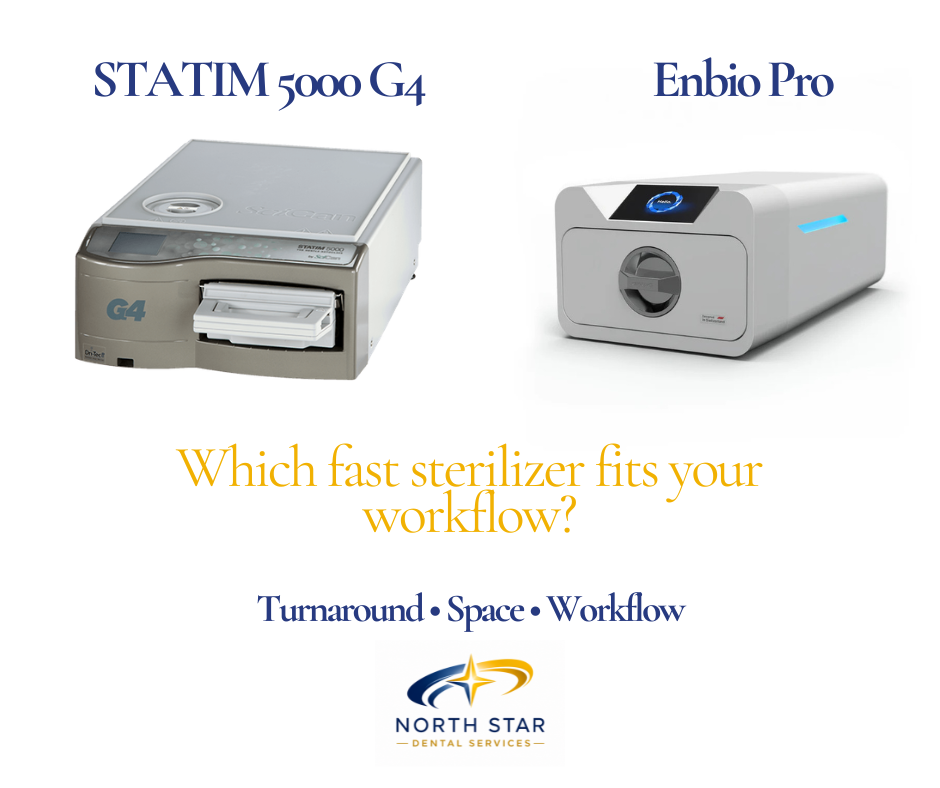
STATIM 5000 G4 vs. Enbio Pro: Which Fast Sterilizer Is Right for Your Dental Practice?
Quick Answer: The STATIM 5000 G4 and Enbio Pro are both capable fast sterilizers, but they fit different workflows. The Enbio Pro stands out for fast wrapped-and-dry instrument turnaround, compact size and lower initial cost. The STATIM 5000 G4 offers its established cassette-style workflow and loading flexibility that many dental practices already know and prefer. The right choice depends on instrument volume, packaging, available space, electrical requirements and how quickly your practice needs wrapped instruments ready for use.
When instrument turnaround becomes a bottleneck, a fast sterilizer can make a noticeable difference in the day.
The STATIM 5000 G4 and Enbio Pro are both designed for fast instrument processing, but they approach the job differently. Both can be good choices. The right one depends on what you're sterilizing, how your team works, the space you have available, and what you expect from the equipment over time.
One of the most important things we've learned from working with sterilizers is that the fastest number on the brochure doesn't always tell you how quickly your instruments will actually be ready.
Here's what we think dental practices should consider before choosing between the STATIM 5000 G4 and Enbio Pro.
A note about this guide: North Star Dental Services sells, services and supports dental sterilization equipment. We regularly service both STATIM and Enbio sterilizers and have firsthand experience with both platforms. Our goal with this comparison isn't to declare one universal winner, but to help practices understand the differences and choose equipment that fits their workflow.
Don't Compare Cycle Time Without Comparing Drying Time
This is probably the biggest difference between the two sterilizers—and one of the easiest specifications to misunderstand.
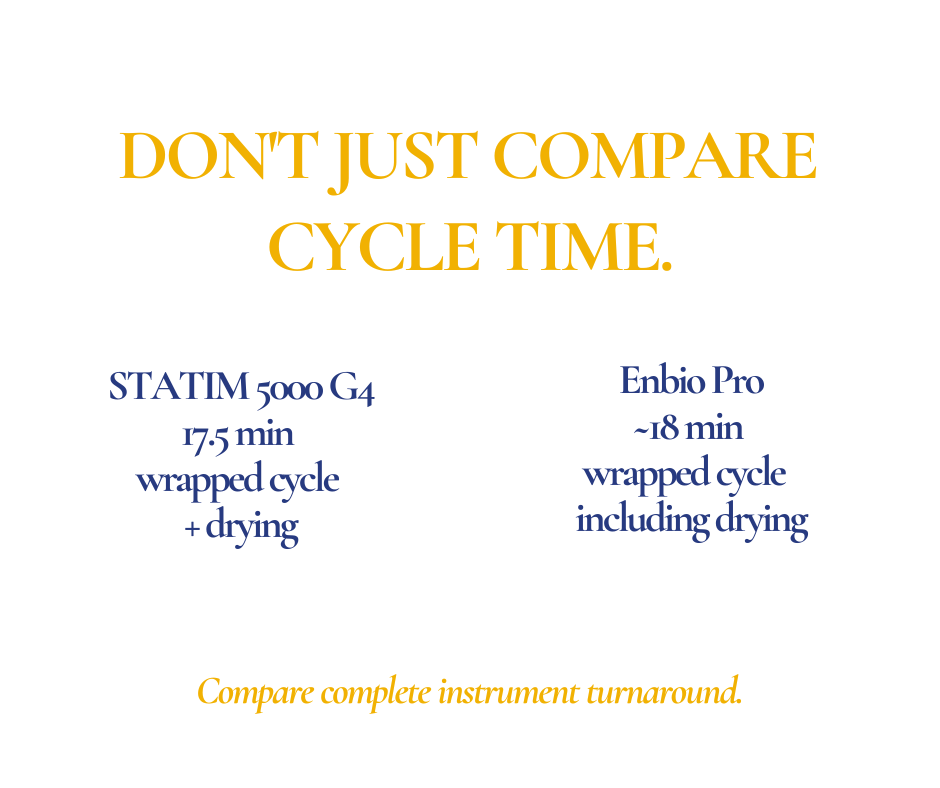
SciCan lists a 9-minute total cycle time for an unwrapped load in the STATIM 5000 G4. For wrapped instruments, the published total cycle time is 17.5 minutes. SciCan specifically notes that these times do not include drying.
Drying matters when you're processing wrapped instruments.
The STATIM automatically begins an air-dry phase after sterilization. Its current U.S. operator manual says that phase runs for 60 minutes by default and can be interrupted. Depending on the load and loading conditions, instruments may be dry sooner. For wrapped instruments intended to remain sterile after processing, SciCan instructs users to allow the wrapped cycle to continue until the air-dry phase is complete.
SciCan also publishes a more practical complete-cycle figure: wrapped loads in the STATIM 5000 G4 can be completed, including drying, in 40 minutes under the conditions used for that manufacturer specification.
Enbio reports its wrapped-instrument turnaround differently. The Enbio Pro can complete a wrapped cycle including drying in approximately 18 minutes, with capacity for up to 16 pouches.
That distinction matters.
If your goal is fast turnaround of wrapped instruments, don't ask only:
How fast is the sterilization cycle?
Ask:
How long until my wrapped instruments are sterilized, dry and ready for the next step?
For that particular workflow, the Enbio Pro has a significant speed advantage.
Think About How You Actually Load a Sterilizer
Published capacity numbers don't tell the entire story either.
Enbio rates the Pro for up to 16 pouches. SciCan publishes capacity of up to 12 pouches for the STATIM 5000 G4, although its current quick-reference instructions show a 10-bag full load when using the drying plate rack for optimal wrapped-instrument drying.
But pouch count isn't the only measure of usable capacity.
The STATIM uses a large removable cassette and has internal loading accessories that some practices find very useful. Instrument size, pouch size, load configuration and the types of instruments your practice processes all affect how much useful work you can get through a sterilizer.
This is one area where we don't think a specification alone should make the decision.
If your team already uses a STATIM and likes the cassette workflow, that familiarity and loading flexibility have real value.
Counter Space Can Change the Decision
The Enbio Pro is considerably narrower and lighter than the STATIM 5000 G4.
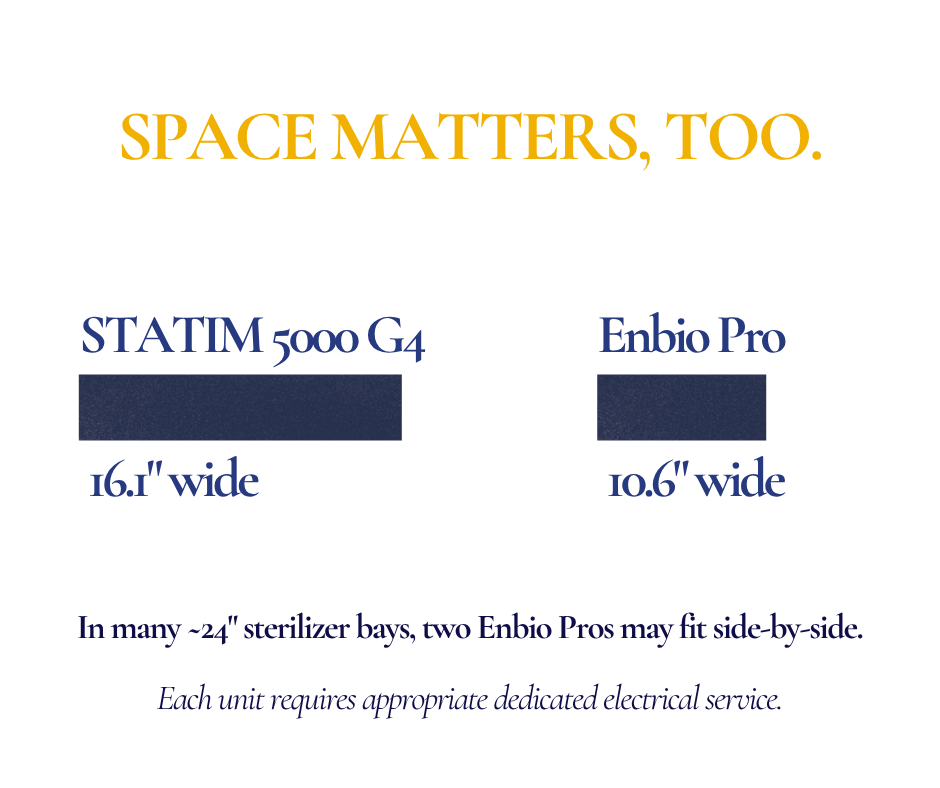
The Enbio Pro measures approximately 10.6 inches wide and weighs about 44 pounds. The STATIM 5000 G4 is approximately 16.1 inches wide and weighs about 73 pounds.
That difference becomes more meaningful when we look at actual dental sterilization centers.
Many sterilizer bays we work with are approximately 24 inches wide. Depending on the cabinetry and installation, two Enbio Pros can physically fit side-by-side in a space that would commonly hold one larger sterilizer.
For a busy practice, that opens up another possibility: instead of one sterilizer, the same cabinetry space may be able to accommodate two independent units.
That can provide additional throughput during busy periods and, perhaps more importantly, redundancy. If one sterilizer needs service, the practice still has another machine available.
But physical space is only part of the equation.
Plan the Electrical Before Planning Two Enbios
The Enbio Pro is a high-power unit. Enbio specifies a 120V 15Amp power supply.
In the installations we plan, each sterilizer needs the appropriate dedicated electrical circut. That means fitting two Enbio Pros into a sterilizer bay doesn't necessarily mean an office can simply plug two machines into the existing electrical setup.
If you're building or remodeling a sterilization center and considering multiple sterilizers, this is something to plan early.
It's much easier to provide the appropriate utilities during construction than discover after the cabinetry is installed that the equipment plan and electrical plan don't match.
What About Service and Repairs?
Both STATIM and Enbio sterilizers eventually require maintenance and service.
We service both.
One feature we've particularly appreciated on newer Enbio units is the additional diagnostic information available when certain failures occur, including QR-code-based information that can help our technicians understand what the sterilizer is reporting.
That doesn't mean every problem can be diagnosed remotely or that repairs are always simple. But better information can help shorten the troubleshooting process in some situations, which can mean less service time and a lower repair bill.
STATIM's G4 platform also provides useful diagnostic and connectivity features. Current STATIM documentation shows access to recent cycle data and fault information, along with network connectivity and maintenance information.
The two systems approach service information differently, but both provide technicians with useful information when something isn't working properly.
Is One More Reliable Than the Other?
We would be careful about making that claim.
We work on both STATIM and Enbio sterilizers, and our service experience hasn't given us a good reason to declare one universally more reliable than the other.
There is something important to understand when looking at Enbio service history, though.
Fast sterilizers can accumulate cycles very quickly.
A practice taking advantage of an approximately 18-minute dry to-dry wrapped cycle can put a surprising number of cycles on a machine in a relatively short period.
That means age alone isn't a particularly useful way to judge how hard a sterilizer has worked.
When we're evaluating sterilizer condition and service history, cycle count matters too.
What About Cost?
At North Star's current pricing, the Enbio Pro is significantly less expensive to purchase than the STATIM 5000 G4.
In our service experience, Enbio replacement parts and repairs have also generally been less expensive.
Those are North Star observations rather than manufacturer claims, and pricing and repair needs can change over the life of the equipment.
Cost also shouldn't be considered by itself.
A less expensive sterilizer isn't the better value if it doesn't fit your workflow. Likewise, paying more for a sterilizer doesn't necessarily mean it will perform the job your practice needs more effectively.
The goal is to buy the equipment that fits the way your practice actually works.
When Does the STATIM 5000 G4 Make Sense?
The STATIM 5000 G4 remains a good choice for many dental practices.
We would give it serious consideration when a practice already has an established STATIM workflow that works well, the team prefers its cassette and loading configuration, or the practice values staying with a platform everyone already knows how to use.
There are also plenty of STATIM 5000s already in service doing exactly what their practices need them to do.
We wouldn't recommend replacing a functioning STATIM simply because another sterilizer is newer, smaller or faster in a particular type of cycle.
If the equipment is serving the practice well, that's important.
When Does the Enbio Pro Make Sense?
The Enbio Pro becomes particularly compelling when fast turnaround of wrapped and dry instruments is the priority.
Its small footprint can also make it a strong option for sterilization centers where counter or tower space is limited.
For practices that process frequent smaller loads throughout the day, want a lower initial equipment investment, or are considering two sterilizers for additional throughput and redundancy, the Enbio Pro deserves serious consideration.
Its serviceability and the generally lower repair costs we've experienced are additional advantages.
North Star's Take
There isn't one sterilizer we would recommend to every dental practice.
For an office with a STATIM 5000 G4 that's working well and fits the team's workflow, there may be very little reason to change.
For a practice purchasing a new fast-turnaround sterilizer today, particularly one that regularly processes wrapped instruments, we think the Enbio Pro is worth a very close look. Its fast complete wrapped-and-dry cycle, compact footprint, lower initial investment and serviceability make it a strong option.
But that's still not enough information to choose a sterilizer.
Before buying, consider what instruments you're processing, how they're packaged, how many loads you run, how quickly you need them back, the space available in your sterilization center, your electrical capacity and whether this will be your only sterilizer or part of a larger system.
Not Sure Which Sterilizer Fits Your Practice?
Choosing a sterilizer isn't just about comparing specifications. Instrument volume, wrapped versus unwrapped loads, available space, electrical requirements and the rest of your sterilization equipment all affect the decision.
North Star can help you look at the complete picture and recommend options that fit your practice.
Looking for an Enbio Pro? We can provide current pricing and help determine whether it's a good fit for your workflow.
Looking for a STATIM 5000? North Star periodically offers refurbished STATIM sterilizers as inventory becomes available. Availability varies, so contact us if you'd like to check current inventory or discuss other options.
Clear direction for your dental practice.
Related Buying Guides
Still deciding what sterilization setup makes sense for your practice?
Read our Dental Sterilizer Buying Guide for help comparing capacity, speed, workflow, Class B requirements and redundancy.