

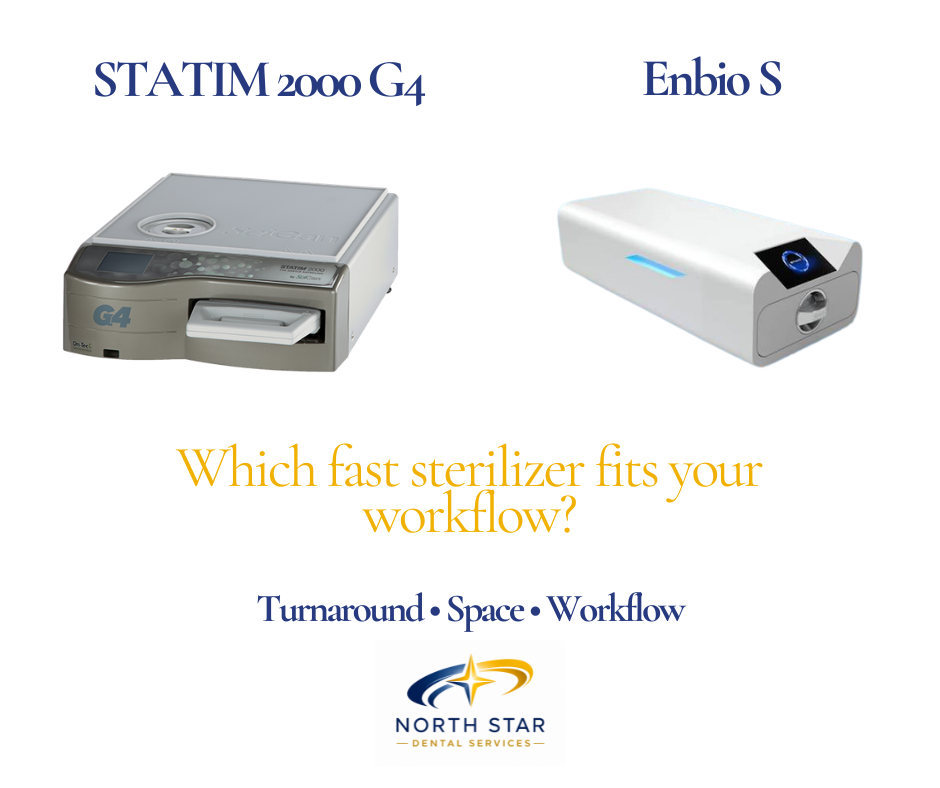
STATIM 2000 G4 vs. Enbio S: Which Sterilizer Is Right for Your Dental Office?
The STATIM 2000 G4 and Enbio S are both excellent compact sterilizers, but they approach instrument processing differently.
When we help an office compare them, we look beyond advertised cycle times. Dry-to-dry turnaround, upfront cost, ongoing maintenance, available space, and how the sterilizer will actually be used can all affect which is the better fit.
Dry-to-Dry Cycle Time
The STATIM 2000 G4 is known for fast sterilization. Its wrapped sterilization cycle is approximately 14 minutes, but that time does not include drying. Drying adds additional time before wrapped instruments are ready to return to storage or use.
The Enbio S can complete a wrapped Class B cycle in approximately 15 minutes including drying, giving it an advantage when fast dry-to-dry turnaround is the priority.
That's an important distinction. When comparing sterilizers, look at when your instruments are actually ready—not just the sterilization portion of the cycle.
Upfront Cost
The Enbio S typically has a lower upfront purchase price than a new STATIM 2000 G4.
That can make it particularly attractive for a practice adding sterilization capacity, looking for a secondary sterilizer, or trying to increase instrument turnaround without making as large an initial equipment investment.
Purchase price, however, is only part of the cost of owning a sterilizer.
Maintenance and Long-Term Cost
Both sterilizers require routine maintenance, but their maintenance costs differ.
The STATIM 2000 G4 has established maintenance items including its cassette seal and filters. Based on the replacement parts we supply and service, routine Enbio maintenance parts generally cost less than comparable STATIM maintenance items.
There is a tradeoff worth considering.
Because the Enbio S is so fast, some offices may run more individual cycles throughout the day rather than waiting to build larger loads. More cycles mean the machine accumulates operating cycles—and associated wear—more quickly.
That doesn't make fast cycles a disadvantage. Fast turnaround can be a significant workflow benefit. It simply means cycle count should be considered alongside maintenance cost when evaluating long-term ownership.
Space, Capacity and Redundancy
The Enbio S has another practical advantage: its small footprint.
A standard dental sterilization cabinetry space for a sterilizer is approximately 24 inches wide. The Enbio S is compact enough that two units can fit side-by-side within that 24-inch space, where the same cabinetry area would typically accommodate one STATIM 2000 G4.
For the right office, that can change the equation considerably.
Two Enbio S units can provide additional processing capacity without requiring additional sterilization cabinetry. They can also provide valuable redundancy. If one sterilizer needs maintenance or service, the second can help keep instruments moving and reduce disruption to the clinical schedule.
There is an important planning consideration: each Enbio requires the appropriate dedicated electrical outlet/circuit. Electrical requirements should therefore be considered when planning two units in the same sterilization area.
With proper planning, the combination of small footprint, increased capacity and redundancy can be a significant advantage.
Which One Would We Choose?
Both can be the right choice. It depends on the practice.
The Enbio S is compelling when an office prioritizes fast wrapped dry-to-dry turnaround, lower upfront cost, lower-cost routine maintenance parts, a small footprint, or the ability to add capacity and redundancy with multiple units.
The STATIM 2000 G4 remains an excellent choice for offices that value its proven platform, established service history, cassette workflow, and long-term durability.
We wouldn't choose between them based on one cycle-time number—or simply choose whichever costs less.
We look at instrument volume, expected cycle count, available space, electrical requirements, workflow, maintenance expectations, redundancy needs, and whether the sterilizer will serve as a primary or secondary unit.
North Star Technician's Note
A faster sterilizer can improve instrument turnaround, but it can also change how a team uses the equipment. When a small load can be processed quickly, teams may run more frequent cycles.
Similarly, a smaller sterilizer isn't simply about saving counter space. Fitting two units into a standard 24-inch sterilizer space can provide both additional capacity and a backup if one unit is down.
Those real-world workflow considerations are why we recommend looking beyond the specification sheet when choosing sterilization equipment.
North Star Dental Services sells and services both STATIM and Enbio sterilizers. Our goal is to help you choose the equipment that makes the most sense for how your practice actually works.
Clear direction for your dental practice.
Related Buying Guides
Not sure which type or size of sterilizer your practice needs?
Read our Dental Sterilizer Buying Guide for help comparing capacity, speed, workflow, Class B requirements and redundancy.