
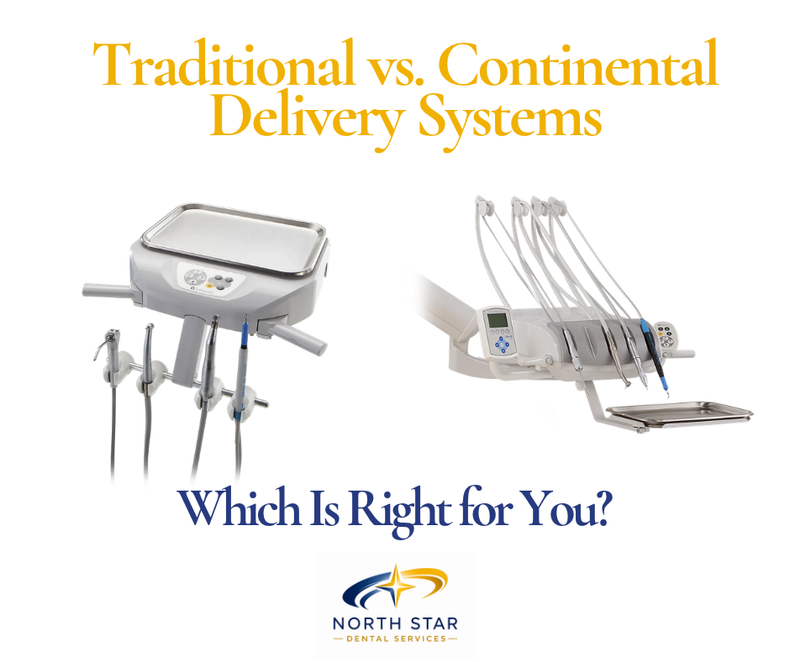
Traditional vs. Continental Dental Delivery Systems: Which Is Right for You?
When choosing a dental delivery system, traditional vs. continental can look like a simple equipment decision.
In reality, it’s mostly a workflow and ergonomics decision.
When comparably equipped, pricing can be similar. The bigger differences are how you retrieve your instruments, how the hoses move, where the delivery system can be positioned, and how the setup feels after a full day of dentistry.
Neither style is right for every doctor.
Here’s what we recommend considering before you choose.
Traditional vs. Continental at a Glance
| Traditional | Continental | |
|---|---|---|
| Handpieces | Hang from holders | Rest above the delivery head |
| Hose feel | More hose length and potential pull | Hoses are supported to reduce pull |
| Hand/wrist ergonomics | Familiar, but requires more handpiece manipulation | Less wrist rotation and hose tension |
| Positioning | Multiple mounting options available | Typically positioned close to the treatment area |
| Small spaces | Flexible mounting can accommodate many layouts | Compact positioning can work especially well |
| Service | Generally easier internal access | May require more disassembly for service |
| Why consider it? | Familiarity and positioning flexibility | Ergonomics and hose management |
The Biggest Difference: How It Feels to Work
One of the biggest differences between the two styles is something that's difficult to appreciate on a specification sheet: how you pick up and use the handpiece.
With traditional delivery, the handpiece hangs in a holder. The clinician retrieves it, brings it into the treatment area and typically rotates or repositions it into the working grip while also managing the hose.
With continental delivery, the handpiece rests above the delivery head with the hose supported. It can be retrieved closer to the position in which it will actually be used.
That can mean:
-
Less hose pull against the hand
-
Less wrist rotation
-
Fewer small handpiece adjustments
-
Less repeated hand and wrist movement throughout the day
Those differences can be particularly meaningful for a clinician experiencing hand or wrist fatigue.
Ergonomics Is Bigger Than the Delivery System
If your wrist, shoulder or back hurts at the end of the day, we wouldn't automatically recommend changing your delivery system.
We'd want to look at the whole operatory.
Your operator stool, patient position, chair height, delivery location, hose condition and your own working position can all contribute to how your body feels at the end of the day.
Hand and wrist fatigue may make the reduced hose pull and handpiece manipulation of continental delivery especially worth considering.
Back or shoulder discomfort may point us toward completely different parts of the operatory.
The goal isn't simply to buy something labeled “ergonomic.” It's to identify what's actually creating the problem.
A Practical Example: Sometimes It's the Hose
If hose drag is what bothers you about traditional delivery, the delivery style itself may not be the entire problem.
We've found in our service work that the finish of the handpiece tubing can make a noticeable difference.
Glossy tubing can have enough surface tack for neighboring hoses to catch against one another as an instrument is retrieved. A more matte-finished tubing tends to slide past adjacent hoses more easily.
We've changed tubing for dentists who were frustrated with hose drag and seen that relatively small change make a significant difference in how their existing delivery system feels.
Sometimes a better setup is the answer—not necessarily a new delivery system.
Consider the Patient and the Operatory
Continental delivery keeps the instruments and hoses close to the treatment area, which can be especially useful in a tight operatory.
That positioning also means the delivery system may be closer to or over the patient during treatment, depending on the system and configuration.
We haven't seen a pattern of patient complaints about continental delivery in the offices we service. Still, clearance and positioning are worth considering for your particular patient population, especially with larger-bodied patients or patients who may be sensitive to equipment positioned close to them.
Traditional delivery offers a different kind of flexibility because there are multiple ways it can be positioned or mounted.
And that leads to an important distinction:
Delivery style and delivery position aren't the same decision.
Traditional systems may be configured in side, rear, swing or other mounting arrangements depending on the equipment and operatory design.
So after deciding that traditional delivery fits the way you want to work, there may be another question to answer:
Where should it go?
What About Service and Long-Term Ownership?
Both styles can provide excellent long-term service.
With traditional delivery, the longer handpiece hoses can experience wear and cost somewhat more to replace simply because more tubing is required. On the other hand, traditional systems generally offer relatively straightforward access to internal components for service.
With continental delivery, hoses stay elevated and tend to stay cleaner and experience less of the floor-level wear we see with traditional systems. However, the mechanisms that support and return the handpieces add components, and accessing the internals can require more disassembly during service.
Neither of those differences makes one system inherently more durable than the other.
They're simply ownership considerations worth understanding before you buy.
Which Delivery Style Should You Consider?
Continental may be worth a closer look if:
-
Hand or wrist fatigue is a concern.
-
You dislike hose pull or drag.
-
You want to reduce handpiece rotation and manipulation.
-
Your operatory is particularly tight on space.
-
You prefer keeping hoses elevated and organized.
-
You're comfortable adapting to a different instrument-retrieval style.
Traditional may be worth a closer look if:
-
You like the familiar delivery style you're already using.
-
Your current workflow works well.
-
You want more flexibility in delivery positioning and mounting.
-
Rear delivery is important to your operatory design.
-
You value relatively straightforward service access.
-
You're not trying to solve a particular ergonomic problem.
Switching After Years of Traditional Delivery?
Don't feel like you need to change simply because continental delivery is considered more ergonomic.
First ask yourself:
What am I trying to improve?
If you're experiencing hand or wrist fatigue, continental delivery deserves a closer look.
If you're primarily frustrated by your hoses, we may want to look at the condition, length and finish of your existing tubing first.
And if you've worked with traditional delivery for decades and genuinely like it, familiarity has value too.
Changing delivery styles changes movements you've repeated thousands of times. There will likely be an adjustment period.
If you're seriously considering making the switch, try a continental system before you buy one whenever possible.
Five Questions to Ask Before You Choose
-
What am I using now, and what do I like or dislike about it?
-
Do I experience hand or wrist fatigue during treatment?
-
Is hose pull or hose management currently a frustration?
-
Do I need flexibility in where my delivery system is mounted?
-
Am I trying to solve an actual problem—or simply replacing what I've always had?
Your answers to those questions are usually more useful than simply comparing feature lists.
Still Not Sure?
Tell us what you're using now and what you wish worked differently.
Sometimes the answer is a different delivery system. Sometimes it's a different mounting configuration, tubing, stool or operatory setup.
North Star Dental Services can help you compare new and pre-owned delivery options across manufacturers and think through what makes sense for the way you actually practice.
Because the goal isn't to sell you one particular style.
It's to help you choose the one you'll be glad you're working with years from now.
North Star Dental Services
Clear direction for your dental practice.